For a poisoning emergency, call 1-800-222-1222. If the victim has collapsed or is not breathing, call 911.
Poison Ivy | Poison Sumac | Poison Oak

Ivy, Sumac and Oak are similar in nature.
|
|
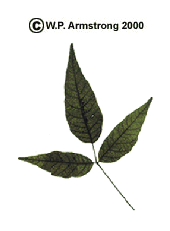

Watch for the Terrible 3's (3 leaves)
Each area has three leaflets, oval shaped pointed and glossy. Grows as a
vine in the East, South and Midwest of the USA. It grows as a tree or shrub
around the Great Lakes, Northern US and Canada. Flowers are greenish white
and clustered in the axils of leaves. Fruit is berry-like, whitish and waxy.
Poison ivy leaves are elliptical, sometimes lobed.
|
|
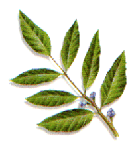
Watch for the Terrible 7 to 13's (7 to 13 pointed
leaves)
Grows as a tall shrub or small tree in bogs or
swamps in Northeast, Midwest, and parts of the Southeast. Each leaf has
clusters of seven to 13 smooth-edged leaflets. Leaves are orange in spring,
green in summer, and yellow, orange, or red in fall. May have yellow-white
berries.

|
|
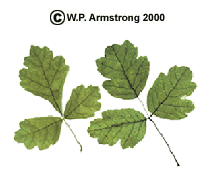

Watch for the Terrible 3's (3 rounded leaves)
Each area has three leaflets that
are rounded. It grows as a shrub in the East. It grows as a shrub but can be
a vine in the West of the USA. It has whitish berries.
The cause of the rash, blisters, and infamous itch is urushiol (pronounced oo-roo-shee-ohl), a chemical in the sap (oil) of poison ivy, oak and sumac plants. Because urushiol is inside the plant, brushing against an intact plant will not cause a reaction. But undamaged plants are rare.
There are 3 different
ways to catch the 3 poisons:
|
| Resource:
http://www.fda.gov/fdac/features/796_ivy.html (page is no longer found) "Poison oak, ivy and sumac are very fragile plants," says William L. Epstein, M.D., professor of dermatology, University of California, San Francisco. Stems or leaves broken by the wind or animals, and even the tiny holes made by chewing insects, can release urushiol. Reactions, treatments and preventive measures are the same for all three poison plants. Avoiding direct contact with the plants reduces the risk but doesn't guarantee against a reaction. Urushiol can stick to pets, garden tools, balls, or anything it comes in contact with. If the urushiol isn't washed off those objects or animals, just touching them--for example, picking up a ball or petting a dog--could cause a reaction in a susceptible person. (Animals, except for a few higher primates, are not sensitive to urushiol.) Urushiol that's rubbed off the plants onto other things can remain potent for years, depending on the environment. If the contaminated object is in a dry environment, the potency of the urushiol can last for decades, says Epstein. Even if the environment is warm and moist, the urushiol could still cause a reaction a year later. "One of the stories I tell people is of the hunter who gets poison oak on his hunting coat," says Epstein. "He puts it on a year later to go hunting and gets a rash [from the urushiol still on the coat]." Almost all parts of the body are vulnerable to the sticky urushiol, producing the characteristic linear (in a line) rash. Because the urushiol must penetrate the skin to cause a reaction, places where the skin is thick, such as the soles of the feet and the palms of the hands, are less sensitive to the sap than areas where the skin is thinner. The severity of the reaction may also depend on how big a dose of urushiol the person got. Quick Action Needed Because urushiol can penetrate the skin within minutes, there's no time to waste if you know you've been exposed. "The earlier you cleanse the skin, the greater the chance that you can remove the urushiol before it gets attached to the skin," says Hon-Sum Ko, M.D., an allergist and immunologist with FDA's Center for Drug Evaluation and Research. Cleansing may not stop the initial outbreak of the rash if more than 10 minutes has elapsed, but it can help prevent further spread. If you've been exposed to poison ivy, oak or sumac, if possible, stay outdoors until you complete the first two steps:
Dealing with the Rash If you don't cleanse quickly enough, or your skin is so sensitive that cleansing didn't help, redness and swelling will appear in about 12 to 48 hours. Blisters and itching will follow. For those rare people who react after their very first exposure, the rash appears after seven to 10 days. Because they don't contain urushiol, the oozing blisters are not contagious nor can the fluid cause further spread on the affected person's body. Nevertheless, Epstein advises against scratching the blisters because fingernails may carry germs that could cause an infection. The rash will only occur where urushiol has touched the skin; it doesn't spread throughout the body. However, the rash may seem to spread if it appears over time instead of all at once. This is either because the urushiol is absorbed at different rates in different parts of the body or because of repeated exposure to contaminated objects or urushiol trapped under the fingernails. The rash, blisters and itch normally disappear in 14 to 20 days without any treatment. But few can handle the itch without some relief. For mild cases, wet compresses or soaking in cool water may be effective. Oral antihistamines can also relieve itching. FDA also considers over-the-counter topical corticosteroids (commonly called hydrocortisones under brand names such as Cortaid and Lanacort) safe and effective for temporary relief of itching associated with poison ivy. For severe cases, prescription topical corticosteroid drugs can halt the reaction, but only if treatment begins within a few hours of exposure. "After the blisters form, the [topical] steroid isn't going to do much," says Epstein. The American Academy of Dermatology recommends that people who have had severe reactions in the past should contact a dermatologist as soon as possible after a new exposure. Severe reactions can be treated with prescription oral corticosteroids. Phillip M. Williford, M.D., assistant professor of dermatology, Wake Forest University, prescribes oral corticosteroids if the rash is on the face, genitals, or covers more than 30 percent of the body. The drug must be taken for at least 14 days, and preferably over a three-week period, says FDA's Ko. Shorter courses of treatment, he warns, will cause a rebound with an even more severe rash. There are a number of OTC products to help dry up the oozing blisters, including:
Desensitization, vaccines, and barrier creams have been studied over the last several decades for their potential to protect against poison ivy reactions, but none have been approved by FDA for this purpose. Right now, prevention seems the best treatment, unless you plan to take lessons from Batman's bane with Poison Ivy's name. Isadora B. Stehlin is a member of FDA's public affairs staff. Also see http://www.fda.gov/ForConsumers/ConsumerUpdates/ucm049342.htm. |
||||||||||||||||||||||||||
| Go to Poison Ivy Go to Poison Oak Go to Poison Sumac |

Visitors
Count is per person no matter how many pages are visited!
Hits
Count is for ALL the hits each visitor makes!

prom dresses 2007 + size