Reference photo: Hugh Wilson

Identification
 | Leaves - 7 to 14 inches
long with 7 to 13 oval leaflets. In general appearance, the leaves
resemble ash, but the leaf stems are always red, which is the best
distinguishing characteristic of poison sumac. Toxicodendron vernix branches support four alternate, pinnately compound leaves which are lobeless and even-edged. These leaves are arranged oppositely with a single leaf on the end of reddish leaf stalks (Eastman, 1995). Identification problems arise since the leaves look much like those of elder, walnut and ash. Just like these others, the leaves of poison sumac turn bright colors in the fall (Frankel, 1991). Also, like poison ivy, the leaves of this plant contain urishiol which causes dermatitis with blisters and vesicles (Woodward, 1985).
|
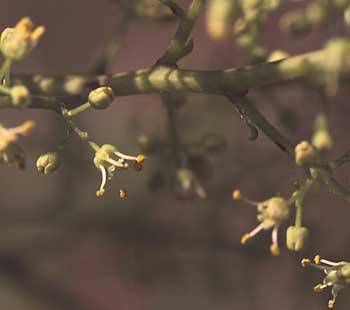
| Flowers- Similar to
Toxicodendron radicans, climbing poison ivy, the flowers of poison sumac
form in axillary clusters that are sweet-smelling.
|
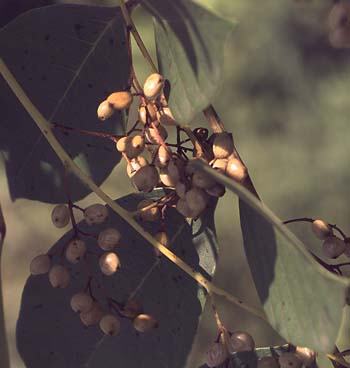
| Fruit -Small, grayish
white shiny berry, hanging in slender, drooping clusters. These ripen in
September and remain on the tree until the following spring.
|
| Reproduction -
Toxicodendron vernix reproduces exactly like poison ivy in terms of
pollination. That is, bees transport the pollen of the male plant to the
pistil of the female plant. There, the pollen combines with the female's
egg giving rise to the fruit in the form of whitish drupes (Frankel,
1991). The seeds in the the drupes are then dispersed by birds (Eastman,
1995).
|
| Range- Found on low wet ground, while the other sumacs are found on well-drained soil. |
General Information
- Toxicodendron finds a home in moist areas, usually in swampy areas. This is the most poisonous plant species in the U.S. (Frankel, 1991).
Geography
Toxicodendron vernix L. |
||
| AREA | STATUS | REFERENCES |
| North America: Continental United States; Canada |
Yes | Frankel, 1991 |
| Eastern North America: United States east of Mississippi; Ontario and eastern Canada |
Yes | Frankel, 1991 |
| Southeastern United States: AL AR DE DC FL GA KY MD NC SC TN VA WV |
Yes | Frankel,1991 |
| Southern Appalachian States: AL GA KY MD NC SC TN VA WV |
Yes | Frankel, 1991 |
| Coastal Plain | Widespread | Roger Hilten, pers. ob. |
| Piedmont | Yes | Roger Hilten, pers. ob. |
| Blue Ridge Mountains | Marginal | Roger Hilten, pers. ob. |
|
? | Roger Hilten, pers. ob. |
| Ridge and Valley | Yes | Roger Hilten, pers. ob. |
| Cumberland Plateau | Yes | Roger Hilten, pers. ob. |
| Central Arch | ? | Roger Hilten, pers. ob. |
| Georgia | Yes | Roger Hilten, pers. ob. |
| Clarke County, Georgia | Yes | UGA Herbarium Specimens |
| Sams Farm | Abundant | Roger Hilten, Pers. Ob. |
|
No | Roger Hilten, Pers. Ob. |
|
Abundant | - |
|
No | Roger Hilten, Pers. Ob. |